What Age Does PAD Start? Risk Factors That Can Bring It On Sooner
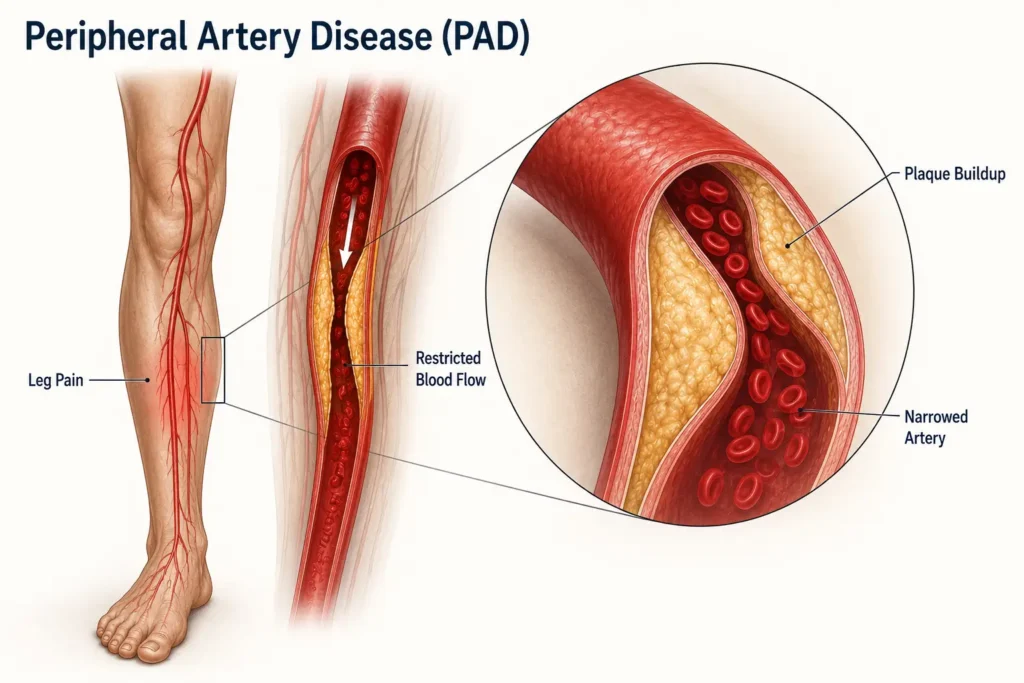
Image: via realmedvision.com
"I'm only 54. How do I already have blocked arteries in my legs?" We hear some version of this question almost every week, and it's a fair one. Most people think of artery problems as something that happens much later in life, if at all.
So, what age does PAD start? For most people, symptoms of peripheral artery disease (PAD) show up after age 50, and the risk climbs with every decade that follows. But the plaque behind PAD starts forming years, even decades, before the first twinge of leg pain. And certain risk factors can push that timeline much earlier.
Knowing why PAD developed isn't about blame. It's about finding the levers you can still pull. In this article, we cover what causes PAD, who's most at risk, and the steps that can slow it down.
The Primary Underlying Causes
Atherosclerosis: A Slow Build Over Decades
Nearly all PAD is caused by atherosclerosis, the gradual buildup of plaque inside the artery wall. It starts when the thin inner lining of an artery, called the endothelium, gets damaged. Tobacco chemicals, high blood sugar, high blood pressure, and excess LDL ("bad") cholesterol all injure this lining.
Once the lining is damaged, LDL cholesterol slips into the artery wall. Your immune system treats it as a threat and sends white blood cells to the area. Over time, cholesterol, inflammatory cells, calcium, and scar tissue harden into plaque. The artery narrows, stiffens, and carries less blood.
This process is slow and silent. Studies of young people who died of unrelated causes have found early fatty streaks in their arteries as early as the teenage years. That's why we often describe PAD as a disease of time. The damage adds up quietly until the narrowing is severe enough to shortchange your leg muscles when they need blood the most, usually during walking.
Why the Legs Are Often Affected
Plaque tends to form where arteries branch, bend, or flex, because blood flow at those spots is turbulent. Your legs have several of them: where the main artery in your abdomen (the aorta) splits in two, at the groin, and behind the knee. The superficial femoral artery, which runs down the thigh, is one of the most common places for PAD to develop.
Because atherosclerosis affects the whole body, blocked leg arteries are often a sign of plaque in the heart and brain too. That's why a PAD diagnosis is also a warning about heart attack and stroke risk.
Less Common Causes, Especially in Younger Adults
When PAD shows up before age 50, we look more carefully for less common causes, such as:
- Buerger's disease (thromboangiitis obliterans): Inflammation and clotting in the small and medium arteries of the hands and feet. It's strongly tied to tobacco use and usually appears before age 45.
- Popliteal artery entrapment syndrome: A muscle or tendon behind the knee squeezes the artery. It's most often seen in young, active people and athletes.
- Fibromuscular dysplasia: Abnormal cell growth in the artery wall that can narrow the vessel. It's more common in women.
- Vasculitis: Inflammation of the blood vessels, often linked to autoimmune conditions.
- Blood clotting disorders: Inherited or acquired conditions that make clots more likely to form in the arteries.
Key Risk Factors: Who Is Most at Risk?
PAD rarely has a single cause. It usually grows out of several risk factors working together over many years. The more of them you have, the earlier PAD tends to appear and the faster it tends to progress.
- Age and Genetics: Age is the strongest risk factor you can't change. National survey data show that about 4.3% of U.S. adults age 40 and older have PAD, and that number rises to roughly 14.5% by age 70. Family history matters too. If a parent or sibling had PAD, a heart attack, or a stroke at a young age, your own risk is higher. Some families pass down very high cholesterol, a condition called familial hypercholesterolemia, or high levels of lipoprotein(a), a cholesterol particle linked to earlier plaque buildup. A one-time blood test can check your Lp(a), and many adults have never had it measured. Race and ethnicity also play a role. According to the CDC, Black Americans have a higher risk of PAD.
- Smoking and Vaping: Smoking is the most powerful PAD risk factor you can change. In a Johns Hopkins study that followed more than 13,000 adults for a median of 26 years, people who smoked more than a pack a day had about 5.4 times the risk of PAD, compared with about 2.4 times the risk of coronary heart disease. In other words, smoking hits the leg arteries especially hard. Quitting helps, and the benefit starts within a few years, but PAD risk can stay elevated for up to 30 years. What about vaping? Research on e-cigarettes and PAD is still early. We do know that nicotine narrows blood vessels and raises heart rate and blood pressure, and studies show vaping can interfere with how blood vessels relax. Our advice is simple: avoid all nicotine and tobacco products, including cigars, chewing tobacco, and vapes.
- Underlying Health Conditions: Diabetes is one of the strongest drivers of PAD. It tends to affect the smaller arteries below the knee, and it dulls nerve sensation in the feet, so wounds can go unnoticed. High blood pressure strains artery walls and speeds up plaque buildup. High LDL cholesterol supplies the raw material for plaque. Chronic kidney disease is linked to more calcified, harder-to-treat arteries. And if you already have heart disease or a history of stroke, atherosclerosis is already active elsewhere in your body, which makes PAD more likely.
- Lifestyle and Environmental Factors: Physical inactivity, excess weight around the waist, and a diet heavy in processed meat, fried food, and added sugar all feed the conditions above. What about stress? There's no strong evidence that stress alone causes PAD. But chronic stress can raise blood pressure and make it harder to quit smoking, eat well, or stay active. The 2024 ACC/AHA guideline lists depression as a PAD "risk amplifier," along with diabetes, tobacco use, chronic kidney disease, and social factors that limit access to care.
How Underlying Causes Are Clinically Diagnosed
Diagnosing PAD and uncovering why it developed go hand in hand. Through a comprehensive diagnostic evaluation, specialists can map out the precise factors contributing to your condition. A typical workup includes:
- A detailed history: Your symptoms, smoking or vaping history, medical conditions, medications, and family history of heart and vascular disease.
- A physical exam: Pulses in your legs and feet, skin and nail changes, and any wounds.
- An ankle-brachial index (ABI): A quick, painless comparison of the blood pressure at your ankle and arm that confirms whether PAD is present.
- Arterial ultrasound: A detailed map of where blood flow is reduced and how severe the narrowing is.
- Blood work: A lipid panel, A1C for blood sugar, kidney function, and sometimes Lp(a). In younger patients, we may also test for clotting disorders or inflammation.
Who Should Ask About PAD Screening?
National cardiology guidelines consider you at increased risk of PAD if you are:
- Age 65 or older
- Age 50 to 64 with risk factors such as diabetes, a history of smoking, high cholesterol, high blood pressure, or a family history of PAD
- Younger than 50 with diabetes plus at least one other risk factor for atherosclerosis
- Living with known plaque in another part of the body, such as the heart, neck (carotid), or kidney arteries, or with an abdominal aortic aneurysm
If you fit any of these groups, ask your doctor about a resting ABI, even if you feel fine. Many people with PAD never have classic leg pain.
Can You Prevent or Slow Progression?
You can't change your age or your genes. But the biggest drivers of PAD are within reach, and small, steady changes add up. These are the steps we focus on with our patients:
- Quit tobacco in every form. This is the single most important step. Combining counseling with medicines like nicotine replacement, varenicline, or bupropion gives you the best odds of success.
- Walk most days. Aim for about 30 minutes, broken into shorter bouts if needed. Regular walking improves leg circulation and helps control weight, blood sugar, and blood pressure.
- Know your numbers. Keep track of your LDL cholesterol, blood pressure, and A1C, and ask your doctor what your personal targets should be.
- Take your statin as prescribed. For people with PAD, guidelines recommend high-intensity statin therapy aimed at lowering LDL by at least 50%, even if your cholesterol already looks "normal."
- Eat for your arteries. Build meals around vegetables, fruit, beans, whole grains, fish, nuts, and olive oil. Cut back on processed meat, fried food, salt, and added sugar.
- Protect your feet. If you have diabetes, check your feet every day and wear shoes that fit well.
- Talk to your family. If you were diagnosed young, your siblings and children may benefit from having their cholesterol, Lp(a), and blood pressure checked early.
Partnering with a Specialist for Answers
PAD can start earlier than most people expect, and it often builds silently for years. The upside is that knowing your risk factors gives you a real head start. The earlier we identify what's driving your PAD, the more we can do to protect your legs, heart, and brain.

Consult with Our Medical Team
Healthy Living Heart and Vein sees patients across Conroe, The Woodlands, Huntsville, Willowbrook, and Spring, Texas, with same-week appointments available. Call (936) 978-0466 to schedule your visit.
Consult Our TeamSources
- CDC: About Peripheral Arterial Disease (PAD)
- Selvin E, Erlinger TP. Prevalence of and Risk Factors for Peripheral Arterial Disease in the United States (NHANES 1999 to 2000). Circulation, 2004
- Joosten MM, et al. Associations Between Conventional Cardiovascular Risk Factors and Risk of PAD in Men. JAMA, 2012
- Johns Hopkins Bloomberg School of Public Health: Study Quantifies Smoking's Strong Link to PAD (Ding et al., JACC, 2019)
- 2024 ACC/AHA Guideline for the Management of Lower Extremity PAD: Key Points (ACC)
Medical Disclaimer: This content is for educational purposes only and does not constitute formal medical advice, diagnosis, or treatment. Always consult a qualified healthcare provider before making changes to your medicines or care.